The short answer: generic security stickers are a few clicks away online, and for sealing a handful of devices they’re often enough. If the labels need to protect your products or your brand, buy from a supplier who prints them to order, can number them, and will send samples to test on your packaging first.
The rest of this guide explains the difference, the types of security label available, and what to check before you order.
Start with what the label has to do
“Security label” covers several different jobs, and the right label depends on which one you need.
- Tamper evidence: showing that a box, bottle, device or document has been opened.
- Warranty protection: sealing screws or casings so you can tell whether a product was opened before a repair claim.
- Anti-counterfeiting: making a genuine product hard to copy and easy to check.
- Asset security: marking equipment so it can be identified and is hard to remove.
Our article on how tamper-proof stickers prevent counterfeiting looks at the brand-protection side in more detail.
Types of security labels
VOID labels
When someone peels a VOID label, the word VOID or a pattern appears, and the label can’t be pressed back down without showing it. Some versions leave the pattern on the surface as well. No-residue versions show the message in the label itself and leave the surface clean, which suits products you don’t want marked.
Destructible labels
These are made from a very brittle film that breaks into small pieces when anyone tries to remove it, so the label can’t come off in one piece and be reused. They’re common on warranty seals and asset labels.
Holographic labels
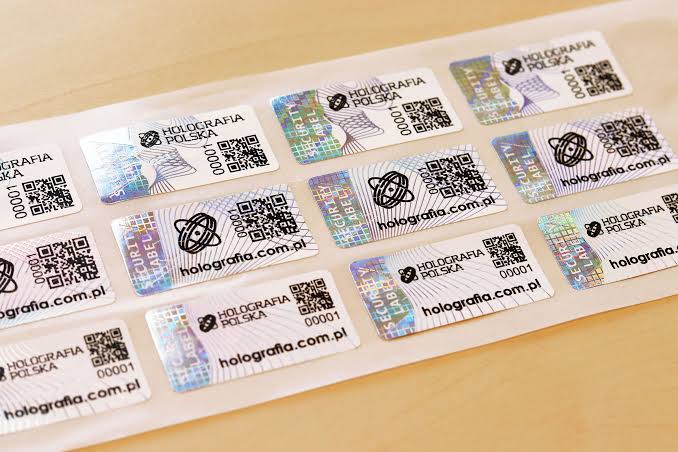
Holograms are hard to copy convincingly and easy for staff and customers to check by eye. They’re used for brand protection, often combined with VOID or destructible features.
Serialised and QR-coded labels
Each label carries a unique number, barcode or QR code. That lets you match labels to products, spot duplicates and, with a verification system behind it, let customers check that a product is genuine. Serialisation is only as good as the control over the numbers, so ask how the supplier prevents duplicates and keeps records.
Tamper-evident tape
For cartons and courier bags, security tape shows a message or pattern if it’s lifted or cut, so it protects the whole opening instead of a single point.
Your options for buying security labels in the UAE
| Where to buy | Good for | Watch out for |
| Online marketplaces | Small quantities of standard VOID or warranty stickers, delivered fast | Generic designs anyone can buy: they show a seal was broken but don’t protect your brand. Quality varies between sellers. |
| Local label suppliers | Custom sizes, printing and numbering, samples, advice on adhesives, and repeat orders | Ask what they make themselves and what they source, and how they control numbering |
| Specialist security printers | High-security holograms and brand protection programmes | Higher minimum orders and longer lead times |
For most UAE businesses, a local label supplier is the practical middle ground: custom labels at sensible quantities, samples before you commit, and someone nearby when you need a repeat order quickly.
Questions to ask before you order
- Can you send samples to test on our actual product or packaging?
- Which surfaces is this adhesive made for? Smooth plastic, cardboard, metal and textured surfaces behave differently, and some plastics are much harder to stick to.
- What temperature range is the adhesive rated for? Labels in UAE warehouses and vehicles see a lot of heat.
- Can you print our logo, text or a unique number on each label?
- How do you control serial numbers so there are no duplicates?
- Will our design be exclusive to us? A security label anyone else can order isn’t much of a security feature.
- What are the minimum order and lead time, and do you hold stock for repeat orders?
Test before you commit
A security label only works if it fails the right way. Before placing a full order:
- Apply samples to the real product and leave them for at least a day before testing. Most label adhesives keep building strength after they’re applied, so peeling straight away isn’t a fair test.
- Try removing labels slowly, quickly and from different angles. The tamper evidence should show every time.
- Warm a label with a hair dryer and try again. Heat is a common way to lift labels cleanly, and in the UAE your labels will meet plenty of it anyway.
- Leave a few samples somewhere hot for a week, then check the adhesive and the print.
Security labels from SMB Infotech
SMB Infotech supplies custom tamper-evident security labels and warranty stickers in Dubai and across the UAE. Tell us what you’re protecting, the surface and the conditions, and we’ll recommend a label and send samples to test on your product before you order. See our tamper-proof labels page for the full range.
Frequently asked questions
What is a VOID label?
A tamper-evident label that shows the word VOID or a pattern when it’s peeled, so it can’t be removed and reapplied without leaving evidence.
Can security labels be removed without leaving a mark?
Well-made tamper-evident labels can’t. Depending on the type, they show a VOID message, break into pieces or leave a pattern on the surface. Test samples on your own product to confirm.
Can security labels carry serial numbers?
Yes. They can be printed with sequential or unique numbers, barcodes or QR codes, so each label can be matched to a product or record.
Do security labels work on plastic?
Yes, with the right adhesive. Some plastics are much harder to stick to than others, so ask for an adhesive made for your surface and test samples first.