Barcode scanners are an essential part of modern retail, logistics, warehousing, healthcare, and inventory management systems. Businesses across Dubai and the UAE use barcode scanners to improve operational accuracy, speed up billing processes, and simplify inventory tracking.
When choosing a barcode scanner, one of the most common questions businesses ask is:
Should you choose a 1D barcode scanner or a 2D barcode scanner?
Both scanners are designed for barcode reading, but they differ in functionality, scanning capability, data storage, and business applications.
In this guide, we’ll explain the difference between 1D and 2D barcode scanners, their uses, advantages, and how businesses can choose the right scanner for their operations.
What is a 1D Barcode Scanner?
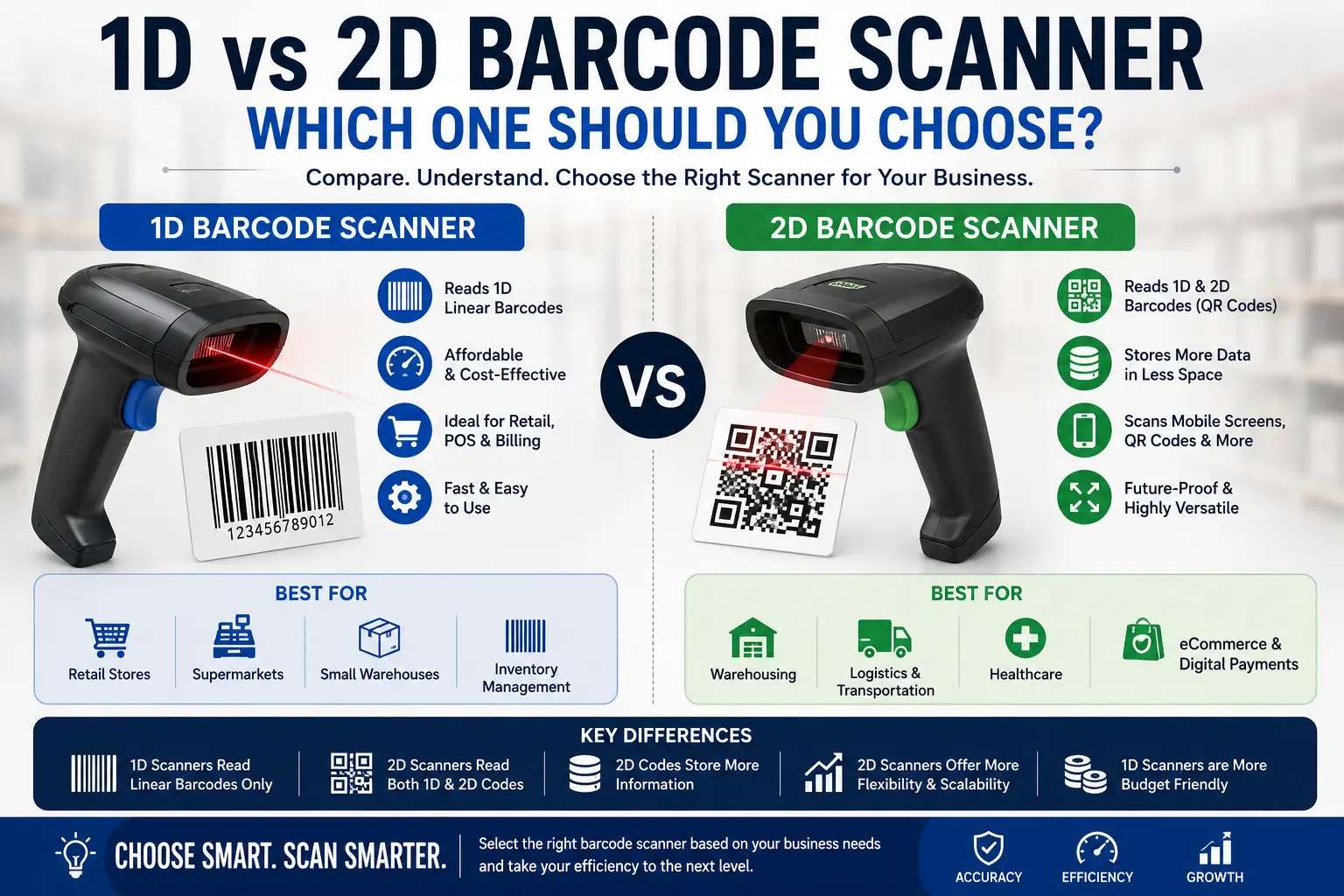
A 1D barcode scanner reads traditional linear barcodes made up of vertical black lines and spaces. Businesses using barcode scanners in Dubai often choose 1D scanners for retail billing, inventory tracking, and warehouse operations.
These scanners are commonly used in:
- Retail stores
- Supermarkets
- Warehouses
- POS billing systems
- Inventory management
1D barcode scanners are mainly designed to scan standard barcodes such as:
- UPC
- EAN
- Code 39
- Code 128
What is a 2D Barcode Scanner?
A 2D barcode scanner can scan both traditional 1D barcodes and advanced 2D codes such as:
- QR codes
- Data Matrix codes
- PDF417
- Aztec codes
Unlike 1D barcodes, 2D barcodes can store larger amounts of information including:
- Product details
- URLs
- Tracking data
- Payment information
- Customer information
2D scanners are widely used in:
- Logistics
- Healthcare
- Manufacturing
- eCommerce
- Advanced warehouse systems
Main Difference Between 1D and 2D Barcode Scanners
| Feature | 1D Barcode Scanner | 2D Barcode Scanner |
| Barcode Type | Linear barcodes | 1D + 2D barcodes |
| Can Scan QR Codes | No | Yes |
| Data Capacity | Limited | High |
| Scanning Speed | Fast | Fast & advanced |
| Cost | Lower | Slightly higher |
| Business Usage | Retail & POS | Logistics, healthcare, warehousing |
| Future Scalability | Basic | Advanced |
How 1D Barcode Scanners Work
1D barcode scanners use a laser or imaging sensor to read horizontal barcode patterns.
The scanner converts barcode information into readable digital data for:
- POS systems
- Inventory software
- Warehouse management systems
Best Applications of 1D Scanners
- Retail billing
- Supermarkets
- Small inventory systems
- Basic stock management
- Product checkout counters
How 2D Barcode Scanners Work
2D barcode scanners use imaging technology to scan both horizontal and vertical barcode patterns.
They can read:
- Printed QR codes
- Mobile screen QR codes
- Damaged barcodes
- High-density data codes
Best Applications of 2D Scanners
- Warehouse automation
- Logistics tracking
- Healthcare systems
- Digital payments
- eCommerce shipping
- Manufacturing operations
Advantages of 1D Barcode Scanners
Affordable Solution
1D scanners are generally more budget-friendly for small businesses.
Easy to Use
These scanners are simple to install and operate.
Ideal for Retail Businesses
Retail stores and supermarkets commonly use 1D scanners for daily billing and checkout operations.
Faster Basic Barcode Reading
For standard barcode formats, 1D scanners offer quick scanning performance.
Advantages of 2D Barcode Scanners
Supports QR Codes
2D scanners can read QR codes used in:
- Digital payments
- Product tracking
- Mobile applications
Higher Data Storage
2D barcodes can store significantly more information compared to traditional 1D barcodes.
Better Scanning Flexibility
2D scanners can read:
- Damaged barcodes
- Small barcodes
- Mobile phone screens
- Rotated barcode images
Future-Proof Technology
Many businesses are shifting toward QR-based and digital inventory systems, making 2D scanners a future-ready solution.
Which Industries Use 1D Barcode Scanners?
1D scanners are commonly used in:
Retail Stores
For billing and product scanning.
Supermarkets
For checkout operations and inventory tracking.
Small Warehouses
For simple inventory management systems.
POS Systems
For barcode-based billing operations.
Which Industries Use 2D Barcode Scanners?
2D scanners are widely used in:
Logistics & Warehousing
For shipment tracking and warehouse automation.
Healthcare
For patient identification and medicine tracking.
Manufacturing
For product traceability and inventory systems.
eCommerce Businesses
For shipping labels and QR code scanning.
1D vs 2D Barcode Scanner: Which One is Better?
The right scanner depends on your business requirements.
Choose a 1D Barcode Scanner If:
- You mainly scan traditional barcodes
- You run a retail or supermarket business
- You need a cost-effective solution
- You use basic inventory systems
Choose a 2D Barcode Scanner If:
- You need QR code scanning
- You use advanced inventory systems
- You manage warehouse or logistics operations
- You want future-ready barcode technology
- You require mobile screen scanning
Are 2D Barcode Scanners Worth It?
Yes, many businesses now prefer 2D scanners because they offer:
- Better flexibility
- Higher compatibility
- QR code support
- Advanced scanning capabilities
As QR code usage continues to grow across retail, logistics, and digital payment systems, 2D barcode scanners are becoming increasingly popular in the UAE market.
How to Choose the Right Barcode Scanner
Before purchasing a barcode scanner, businesses should consider:
Business Type
Retail businesses may only need 1D scanners, while logistics and healthcare operations benefit from 2D scanners.
Barcode Usage
Choose a scanner based on whether you scan:
- Traditional barcodes
- QR codes
- Mobile screen codes
- Shipping labels
Integration Compatibility
Ensure the scanner works with:
- POS systems
- Warehouse software
- Inventory systems
- ERP software
Scalability
Businesses planning future expansion should consider investing in 2D barcode scanners.
Why Businesses in UAE Use Barcode Scanners
Businesses across Dubai and the UAE use barcode scanners to:
- Improve operational efficiency
- Reduce manual errors
- Speed up billing processes
- Improve inventory accuracy
- Simplify warehouse management
Modern barcode scanning systems support faster and more accurate business operations. Businesses using barcode labels with barcode scanners can improve inventory accuracy and simplify warehouse management systems.
Conclusion
Both 1D and 2D barcode scanners offer valuable benefits depending on business requirements. While 1D scanners are ideal for basic retail and billing operations, 2D scanners provide advanced functionality, QR code compatibility, and future-ready scanning technology.
Businesses should choose a scanner based on their operational needs, barcode usage, and long-term scalability goals.
SMB Infotech provides reliable barcode scanner solutions for retail, warehouse, logistics, healthcare, and industrial businesses across Dubai and the UAE.
FAQs – Frequently Asked Questions
Q1. What is the difference between 1D and 2D barcode scanners?
Ans – 1D barcode scanners read traditional linear barcodes, while 2D scanners can scan both linear barcodes and QR codes.
Q2. Can a 2D barcode scanner scan 1D barcodes?
Ans – Yes, 2D barcode scanners can scan both 1D and 2D barcode formats.
Q3. Which barcode scanner is best for retail stores?
Ans – 1D barcode scanners are commonly used in retail stores for billing and product scanning.
Q4. Are 2D barcode scanners better for warehouses?
Ans – Yes, 2D scanners are ideal for warehouses because they support QR codes, damaged barcode scanning, and advanced inventory tracking.
Q5. Do businesses in UAE use QR code scanners?
Ans – Yes, many businesses in UAE use 2D barcode scanners for QR code payments, logistics, and inventory management.