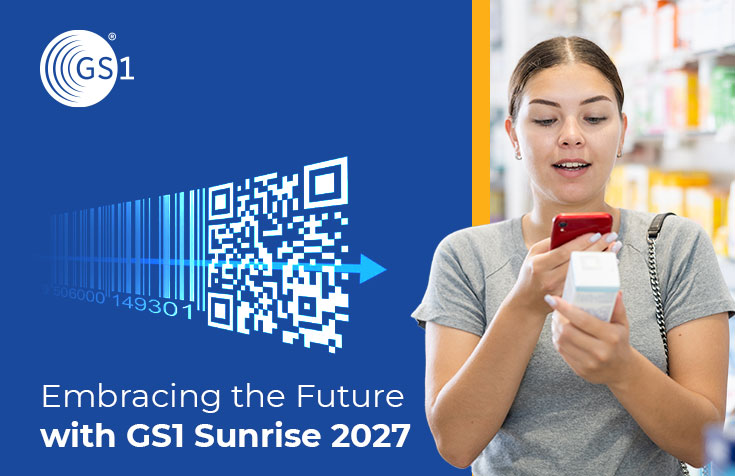
The barcode on a supermarket shelf has barely changed in fifty years. That’s starting to shift. GS1, the organisation behind retail barcodes, has set a goal for checkouts around the world to read 2D codes, the square QR and DataMatrix kind, by the end of 2027. The programme is called Sunrise 2027, and GS1 UAE has publicly pointed to the same goal.
If you run a shop, supply products to retailers or look after labelling for a brand in the UAE, the next year or so is when the groundwork happens.
What Sunrise 2027 actually is
Sunrise 2027 is GS1’s target for retail checkout systems to read and process GS1-standard 2D barcodes alongside today’s EAN and UPC barcodes by the end of 2027. Two 2D formats are in scope: the GS1 DataMatrix, and the QR code carrying a GS1 Digital Link. Both have been approved for use at the checkout since 2021.
A 2D code holds far more than a product number. Alongside the GTIN, it can carry a batch number, an expiry date or a serial number. That makes things possible that a normal barcode can’t do, such as stopping expired stock at the till or tracing a recalled batch quickly. And with GS1 Digital Link, the same QR code the cashier scans can take a shopper to product information on their phone.
What it isn’t
A fair amount of coverage gets this part wrong. Sunrise 2027 isn’t a law, and it doesn’t switch off the old barcode. GS1’s implementation guideline for 2D barcodes at retail checkouts (the version ratified in December 2025) keeps the EAN or UPC barcode on the pack until 90% of checkout scanners can read 2D codes. Until then, packs carry both, with the 2D code placed within 50 mm of the centre of the linear barcode.
So nothing breaks on 1 January 2028. What changes is that more and more packs carry a 2D code, and retailers who can’t read them miss out on the extra information.
The UAE already scans 2D codes every day
For UAE pharmacies, none of this is new. Under the Ministry of Health and Prevention’s 2021 traceability decree, medicine packs sold in the UAE must carry a serialised GS1 DataMatrix, tracked through the national Tatmeen platform. Dubai Health Authority started batch-level tracing of medicines with GS1 DataMatrix codes even earlier, in 2017.
Sunrise 2027 takes the same idea from the pharmacy counter to the supermarket checkout.
What it means for UAE retailers
Check whether your scanners can read 2D codes
This is the part most likely to cost money. Barcode scanners come in three basic types, and only one of them reads 2D codes. Laser scanners and linear imagers read ordinary 1D barcodes only. Area imagers, usually just called 2D imagers, read both 1D and 2D codes, and can read codes on phone screens too.
Some very popular models can’t read 2D codes at all. The Zebra LS2208 and the Honeywell 1202g are laser scanners. The Zebra LI2208 and LI4278 and the Datalogic QuickScan QD2131 are linear imagers. All five read 1D barcodes only. On the other side, the Zebra DS2208 and DS7708, the Honeywell 1470g and 1602g, and the Datalogic QD2430 are area imagers that read both. If you’re not sure what’s on your counters, the model number on the underside of the scanner will tell you.
Check your till software as well as the scanner
A 2D scanner reading a GS1 Digital Link QR code sends a full web address to your till. Unless the scanner or the POS software knows how to pull the product number out of that address, the till won’t recognise the item. Zebra documents a GS1 Digital Link parsing option for its retail scanners, and other makers have their own versions. Ask your POS software provider whether they support GS1 2D barcodes and Digital Link before you spend money on new scanners.
Brief the people on the tills
Cashiers need to know that a pack may carry two codes and that either one should scan. Five minutes at a team meeting saves a lot of confusion at the counter.
What it means for brands and manufacturers
Plan for two codes on the pack
During the changeover, packs carry both the EAN or UPC barcode and a 2D code. That means rethinking label and packaging artwork to fit both, with the 2D code kept close to the linear barcode.
Get your product data in order
A GS1 Digital Link points to information about your product, so that information has to be right. In the UAE, product barcodes and the data behind them come through GS1 UAE.
Make sure your printers can produce codes that scan
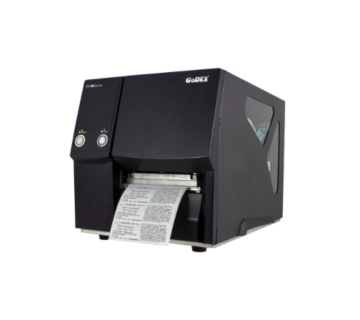
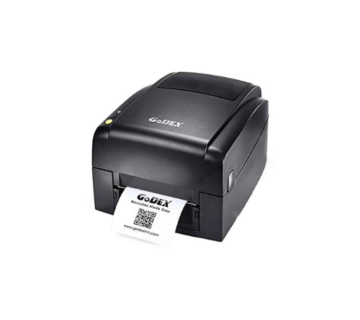
Small 2D codes need fine detail. Thermal transfer label printers at 300 dpi handle GS1 DataMatrix and QR codes well on most label materials. Whatever you print with, test a sample batch on the scanners your retail customers actually use, and get the codes verified if a customer asks for graded barcodes.
A sensible plan from here
- Between now and early 2027, check your scanners and till software, and ask your suppliers and retail customers what they’re planning.
- Through 2027, replace 1D-only scanners as they come up for renewal, and start putting both codes on products sold through the larger retailers.
- After that, treat the 2D code as the one that carries the useful information, and keep the linear barcode on pack for as long as the guideline requires it.
Talk to us about 2D-ready scanners and labels
SMB Infotech supplies 2D barcode scanners, label printers and labels in Dubai and across the UAE. If you’re not sure whether your current scanners can read 2D codes, send us the model numbers. We’ll tell you which ones need replacing and which ones are already fine.
Frequently asked questions
Is Sunrise 2027 mandatory in the UAE?
It isn’t a law. It’s an industry target coordinated by GS1 and supported by GS1 UAE. Individual retailers can still require 2D codes from their suppliers.
Will EAN barcodes stop working after 2027?
No. GS1’s guideline keeps the linear barcode on pack until 90% of checkout scanners can read 2D codes, so both will be in use for a while yet.
Can my barcode scanner read QR codes?
Only if it’s an area imager. Laser scanners and linear imagers read 1D barcodes only. Look up your scanner’s model number in the manufacturer’s specifications to be sure.
What is GS1 Digital Link?
It’s a way of turning a product’s GS1 numbers, its GTIN and optionally a batch or serial number, into a web link that fits inside a QR code. One code then works at the checkout and on a shopper’s phone.
Can my existing label printer print 2D barcodes?
Most thermal label printers can. For small codes, 300 dpi gives better results than 203 dpi. Always test-scan a sample before a full print run.