Choosing the right label technology is essential for businesses that rely on barcode printing, shipping, inventory management, and product identification. Two of the most commonly used options are direct thermal labels and thermal transfer labels.
Although both use heat to produce printed information, they differ in durability, printing method, and ideal applications. Understanding these differences can help businesses select the most suitable labeling solution for their operational needs.
What Are Direct Thermal Labels?
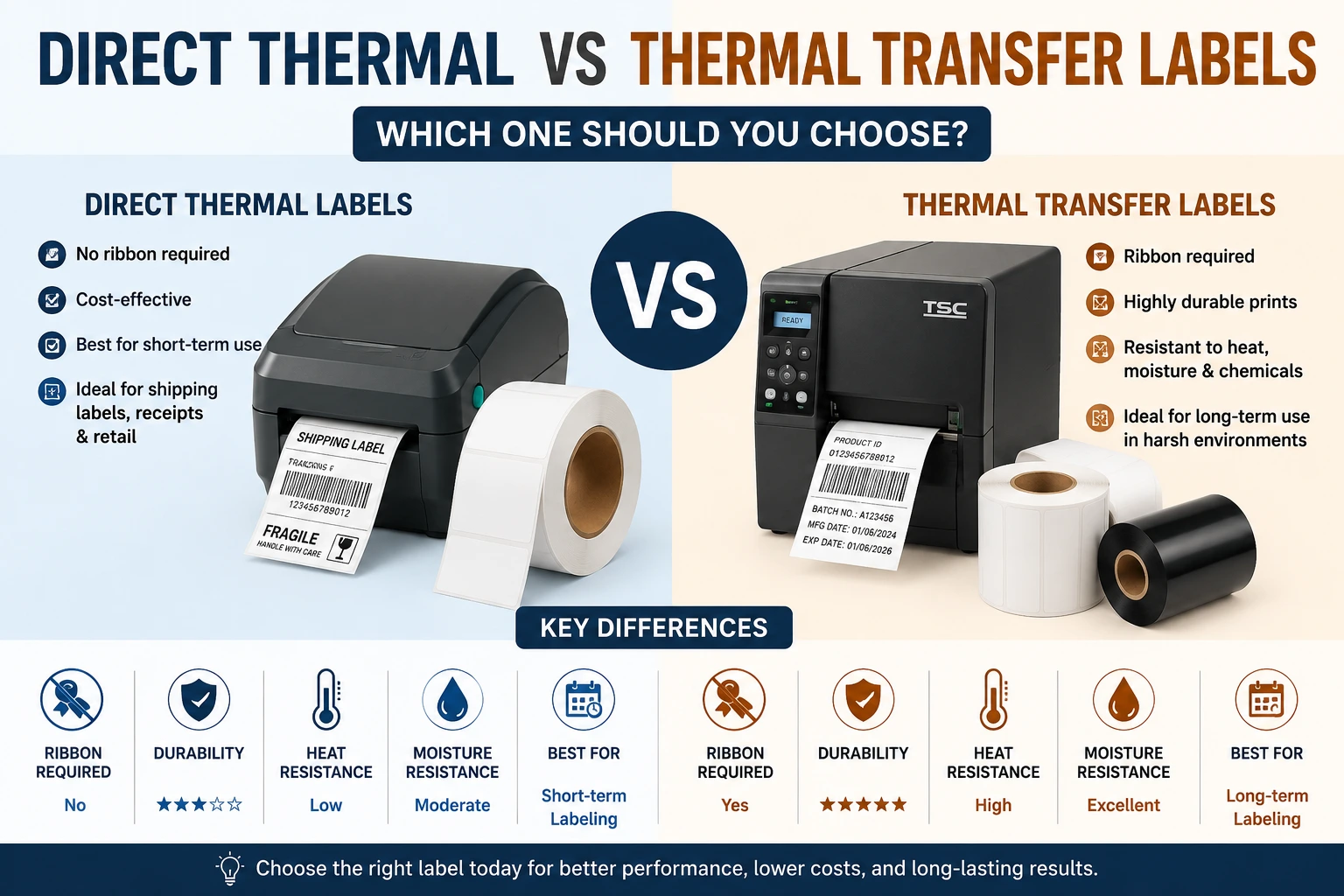
Direct thermal labels are made with a heat-sensitive coating that darkens when exposed to the print head. They do not require ink, toner, or ribbons, making them a simple and cost-effective solution for short-term labeling.
Common Applications
- Shipping labels
- Retail receipts
- Food packaging
- Temporary product labels
What Are Thermal Transfer Labels?
Thermal transfer labels use a ribbon that transfers ink onto the label surface through heat. This creates highly durable prints that resist fading, moisture, chemicals, and abrasion.
Common Applications
- Asset tracking
- Warehouse labeling
- Manufacturing
- Outdoor labeling
- Long-term product identification
Direct Thermal vs Thermal Transfer Labels
| Feature | Direct Thermal | Thermal Transfer |
| Ribbon Required | No | Yes |
| Print Durability | Moderate | Excellent |
| Heat Resistance | Low | High |
| Moisture Resistance | Moderate | Excellent |
| Outdoor Use | Limited | Recommended |
| Best For | Short-term labeling | Long-term labeling |
Advantages of Direct Thermal Labels
Lower Operating Costs
Since no ribbon is required, businesses reduce consumable costs.
Easy Maintenance
Fewer components mean simpler printer maintenance.
Faster Printing
Ideal for high-volume receipt and shipping label printing.
Advantages of Thermal Transfer Labels
Longer Print Life
Print remains readable for extended periods.
Better Resistance
Suitable for harsh environments involving heat, chemicals, and moisture.
High Barcode Accuracy
Produces sharp, high-quality barcodes that scan consistently.
Using high-quality barcode labels helps ensure clear printing and reliable barcode scanning across different applications.
Which Option Should You Choose?
Choose Direct Thermal Labels if you need:
- Temporary labels
- Shipping labels
- Retail receipts
- Cost-effective printing
Choose Thermal Transfer Labels if you need:
- Durable barcode labels
- Warehouse inventory labels
- Manufacturing labels
- Outdoor applications
Industries That Use These Labels
Direct Thermal Labels are commonly used in:
- Retail
- Logistics
- Food delivery
- Healthcare
Thermal Transfer Labels are widely used in:
- Manufacturing
- Warehousing
- Automotive
- Chemical industry
- Asset management
Proper label printing techniques help businesses maintain accurate product identification and inventory management.
Tips for Choosing the Right Thermal Labels
Before selecting a label type, consider:
- Expected label lifespan
- Storage conditions
- Exposure to sunlight
- Moisture levels
- Barcode scanning requirements
- Printer compatibility
Choosing the right label technology helps improve print quality, reduce replacement costs, and ensure reliable barcode scanning. Businesses should select thermal labels that match their printing requirements and environmental conditions for the best results.
Frequently Asked Questions
Q1. What is the difference between direct thermal and thermal transfer labels?
Ans – Direct thermal labels print without a ribbon, while thermal transfer labels require a ribbon to produce durable prints.
Q2. Which labels last longer?
Ans – Thermal transfer labels generally last much longer because the printed image is more resistant to heat, moisture, and abrasion.
Q3. Are direct thermal labels waterproof?
Ans – Most direct thermal labels are not designed for long-term exposure to water or harsh outdoor conditions.
Q4. Which industries use thermal transfer labels?
Ans – Manufacturing, warehousing, logistics, healthcare, and asset management commonly use thermal transfer labels.
Q5. Can both label types print barcodes?
Ans – Yes. Both direct thermal and thermal transfer labels can produce high-quality barcodes when used with compatible printers.
Conclusion
Both direct thermal and thermal transfer labels offer unique advantages depending on the intended application. Businesses that require short-term labeling often prefer direct thermal labels, while those needing long-lasting, durable identification benefit from thermal transfer labels.
Selecting the right labeling solution improves operational efficiency, barcode readability, and overall printing performance.