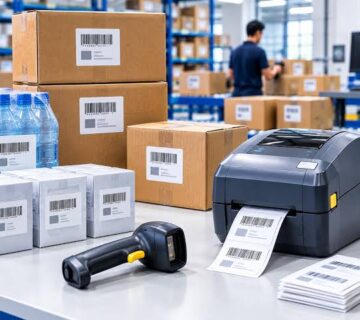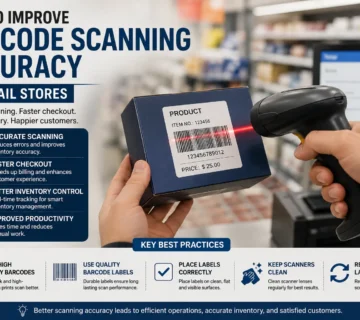
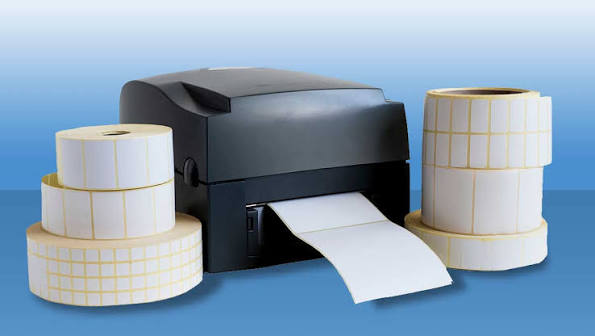
Most of the labels in a Dubai warehouse were printed with heat, not ink. Courier labels, shelf barcodes, carton labels and many product labels all come off thermal printers, because thermal printing is fast, cheap to run and needs no ink cartridges. The catch is that a thermal label has to suit both the job and the conditions it lives in, and UAE conditions are tougher than most.
Heat, sunlight and humidity find out the wrong label quickly here. This guide covers what thermal labels are, how temperature affects them, and which type to choose for barcodes, shipping and product packaging.
What thermal labels are
Thermal labels are labels printed with heat. A thermal printer’s printhead is a row of tiny heating elements that switch on and off to form text, barcodes and graphics. There are two ways the heat turns into print, and the difference shapes almost every decision in this guide.
- Direct thermal labels carry a heat-sensitive coating that turns black wherever the printhead heats it. No ribbon or ink is needed.
- Thermal transfer labels are plain label stock. The printhead heats a ribbon, and the ribbon’s ink melts onto the label surface.
Direct thermal is simpler and cheaper to run. Thermal transfer costs a little more per label because you also buy ribbon, but the print lasts much longer and it works on plastic films as well as paper. Our guide to direct thermal and thermal transfer labels compares the two in detail.
How temperature affects thermal labels
This is the question that matters most in the UAE, and the answer is different for each type.
Direct thermal labels react to any heat
A direct thermal coating is built to darken when it gets hot, and it can’t tell a printhead from a hot dashboard. Zebra’s printer documentation warns that direct sunlight or heat sources can “expose” direct thermal media. Ricoh, one of the major thermal paper makers, recommends keeping unused thermal paper in the dark at no more than 35°C and 85% relative humidity. One manufacturer’s guidance puts the point where thermal paper starts to discolour at about 70°C, and warns specifically against hot enclosed spaces such as a car boot.
A Dubai summer runs well past 35°C outdoors. Labels kept for weeks in a storeroom without air conditioning, in a container on the dock or in a van parked in the sun slowly grey across the whole surface until the barcode stops scanning. There’s no warning before it happens.
Heat isn’t the only risk. Direct thermal print can also be damaged by:
- Sunlight and strong fluorescent light, which yellow or grey the background over time.
- Alcohol and solvents, including alcohol-based hand sanitiser and some cleaning sprays.
- PVC sleeves, wallets and films, because the plasticisers in PVC can fade the image.
- Rubbing and scratching, which can leave dark marks.
Thermal transfer labels cope far better
Thermal transfer print doesn’t react to heat once it’s on the label, so a hot warehouse won’t darken it. Durability comes down to the ribbon. Wax ribbons suit paper labels in normal conditions. Wax-resin ribbons resist smudging and handling better. Resin ribbons on synthetic labels stand up to heat, sunlight, abrasion and chemicals, and they’re the right choice for anything stored outdoors or kept for years. Our comparison of wax and resin ribbons explains the difference.
Heat affects the adhesive too
The glue is easy to forget. In hot storage, label adhesive softens and can ooze from the edges of the roll, which leads to labels sticking inside the printer and paper jams. In cold rooms and freezers the opposite happens: standard adhesive won’t grip a chilled surface, so labels fall off. Freezer-grade adhesives are made for that job and need to be specified when you order.
Storing thermal labels in the UAE
- Keep rolls in their packaging until they go on the printer.
- Store them in an air-conditioned room, away from windows, heaters and the tops of machines.
- Use the oldest stock first.
- Don’t leave spare rolls in vehicles, on loading bays or anywhere in direct sun.
The best thermal labels for each job
Barcode labels for shelves and stock
For price labels and markdowns that only need to last a few weeks, direct thermal paper keeps costs down. For product and stock labels that stay on the shelf for months, choose thermal transfer paper labels with a wax or wax-resin ribbon. Labels that get handled a lot, face moisture or need to last for years, such as asset labels, should be synthetic film (polypropylene or polyester) printed with a resin ribbon.
Shipping labels
Shipping is where direct thermal makes the most sense. The label only has to survive the journey, couriers scan it within days, and there’s no ribbon to change during a busy dispatch shift. The standard size is 100 x 150 mm (4 x 6 in), which is the format most courier and e-commerce systems produce for thermal printers.
- Choose top-coated direct thermal if parcels sit in humid conditions, travel in hot vans or get handled a lot. The top coat protects the image from moisture, oils and scuffs.
- Use a permanent adhesive that grips cardboard well, including recycled and dusty cartons.
- For busy packing benches, fanfold labels (a folded stack rather than a roll) let you load more labels at once.
Our guide to types of shipping labels covers formats and sizes in more detail.
Product packaging labels
Packaging labels have to look right and stay put on the actual container. That usually means thermal transfer, because it prints on plastic films and gives sharp text and barcodes. Match the material to the container:
- Paper for cartons, boxes and dry goods.
- Polypropylene (PP) for bottles and jars, especially where there’s moisture or refrigeration.
- Polyethylene (PE) for squeezable bottles and tubes, because it flexes with the container instead of wrinkling or lifting.
- Polyester (PET) for labels that face heat, chemicals or abrasion, or need to last for years.
If the labels go on food sold in the UAE, check the language rules before you design them. Food labels must be in Arabic, or in Arabic and English. If Arabic is added as a sticker over imported packaging, the sticker needs approval from the authorities before use, so it’s simpler to build the Arabic into the label design from the start.
Quick reference
| Job | Label type | Material | Ribbon | Needs to last |
| Price labels and markdowns | Direct thermal | Paper, top-coated | None | Weeks |
| Shipping labels | Direct thermal, 100 x 150 mm | Paper, top-coated | None | Days to weeks |
| Stock and carton labels | Thermal transfer | Paper | Wax or wax-resin | Months |
| Product packaging | Thermal transfer | PP, PE or PET film | Wax-resin or resin | The product’s shelf life |
| Asset tags and outdoor use | Thermal transfer | Polyester (PET) | Resin | Years |
Check these before you order
- Width and roll size. Most 4-inch desktop printers print up to 104 mm wide and take rolls up to about 127 mm across. Industrial printers take larger rolls.
- Core size. Desktop printers usually take a 25 mm (1 in) core, industrial printers usually a 76 mm (3 in) core.
- Gap labels, black mark labels and continuous media each need the printer’s sensor set to match, followed by a calibration.
- Labels can be wound facing out or facing in. Check which way your printer or applicator needs them.
- For small labels and 2D codes such as QR codes, a 300 dpi printer gives cleaner results than 203 dpi.
- Test them on your printer, your product and in your real storage conditions before ordering in volume.
Signs you’re using the wrong labels
- Barcodes fade or the background turns grey before the stock is sold. The label is probably direct thermal where thermal transfer was needed, or it’s being stored too hot.
- Print smudges when rubbed. The ribbon doesn’t suit the label, for example a wax ribbon on a synthetic film.
- Labels lift at the corners or fall off cold cartons. The adhesive is wrong for the surface or the temperature.
- The printhead wears quickly or starts leaving white lines. Abrasive, low-grade labels or a ribbon narrower than the label are common causes.
- Glue builds up on the roller and labels keep jamming. The rolls have probably been stored somewhere hot.
Buying thermal labels in Dubai
The cheapest roll rarely turns out to be the cheapest label once you count reprints, rejected shipments and printhead wear. A good thermal label supplier in the UAE will ask what you’re labelling, where it’s stored and how long it needs to last, then match the labels and ribbon to your printer.
SMB Infotech supplies direct thermal and thermal transfer labels in Dubai and across the UAE, in paper and synthetic materials and in standard or custom sizes, along with ribbons and printers to match. Tell us what you’re labelling and where it will be kept, and we’ll send samples to test before you order in volume.
Frequently asked questions
What are thermal labels?
Labels printed with heat instead of ink. Direct thermal labels have a heat-sensitive coating that darkens where the printhead heats it. Thermal transfer labels are printed through a ribbon whose ink melts onto the label.
How does temperature affect thermal labels?
Heat darkens direct thermal labels, before and after printing, so storage above about 35°C, direct sun or time in a hot vehicle shortens their life. Thermal transfer print isn’t affected by heat in the same way. In cold rooms the main risk is the adhesive, which needs a freezer-grade formula to stick.
Do thermal labels fade?
Direct thermal labels fade or darken over time, faster in heat and sunlight. Thermal transfer labels printed with the right ribbon can stay readable for years.
What size are thermal shipping labels?
The standard size is 100 x 150 mm (4 x 6 in).
Do thermal labels need ink?
No. Direct thermal labels need no ink or ribbon. Thermal transfer labels use a ribbon rather than ink cartridges.